AI product
tm.educ
Lesson and payment accounting between a teacher and a student
- Role
- Founder
- Period
- 10 days
- Team
- Solo, with AI
- Status
- Finishing: AI layer being integrated
How it works
01Setup
The teacher sets up subjects, prices and packages; the student arrives by link.
02Lesson
Created, confirmed, cancelled or moved — the schedule is guarded against overlaps.
03Balance
A taught lesson comes off the package automatically.
04Reminder
The package runs low and the bot writes on its own, sparing the conversation.
05Payment
An invoice, a payment link, a webhook, and the payment state updates.
What it is
tm.educ is a bot and mini app for tracking lessons and payments between a private teacher and a student. A tutor, a teacher, a coach — any pair where lessons come in packages and have to be counted.
It has one job: get lesson administration out of the chat thread.
Problem
The accounting lives in a messenger. How many lessons each student has left, who has paid, who was rescheduled — all of it is recovered by scrolling back.
Payment reminders are their own difficulty. The conversation is awkward, so it gets postponed, and some lessons end up taught on credit.
How it is built
One system, two sides. The teacher sees students, subjects, prices, packages, the schedule, the balance of paid lessons and the payments. The student sees their own schedule, paid lessons, balance and what is coming next.
The loop closes: a lesson is taught and the balance updates; the package runs out and the bot asks for payment; the student pays and the teacher confirms; the balance is current again. Nobody recounts anything by hand.
What the AI does
The AI layer has two levels. The first is the teacher's assistant: a free branch answers routine questions without calling a model, while the branch for harder questions goes through an LLM and is still in development.
The second is the AI tutor: retrieval over a catalogue of books and courses. Only material a human has vetted goes into that catalogue — own material, books and courses. Storage and search run on a self-hosted PostgreSQL with pgvector in Russia; Supabase was considered and rejected over data residency requirements.
The AI layer is in the final stage of integration.
How it works
01Setup
The teacher sets up subjects, prices and packages; the student arrives by link.
02Lesson
Created, confirmed, cancelled or moved — the schedule is guarded against overlaps.
03Balance
A taught lesson comes off the package automatically.
04Reminder
The package runs low and the bot writes on its own, sparing the conversation.
05Payment
An invoice, a payment link, a webhook, and the payment state updates.
06Confirmation
The teacher confirms receipt and the balance is current again.
What already works
- Roles and sign-up
- Teacher and student, time zones, and acceptance of the terms.
- Subjects, prices and packages
- Price is set per subject; lessons are sold in packages.
- Student card
- Paid and planned lessons, history, and archiving.
- Lessons and schedule
- Creating, confirming, cancelling, moving — and protection against overlaps.
- Lesson balance
- The balance recalculates itself and reads the same to both sides.
- Automatic reminders
- About the lesson coming up and the package running out.
- Mini app with two dashboards
- Separate screens for the teacher and for the student.
- Payment path
- Invoicing, a Robokassa payment link, a webhook and a payment-state update; confirmation stays with the teacher.
Interface
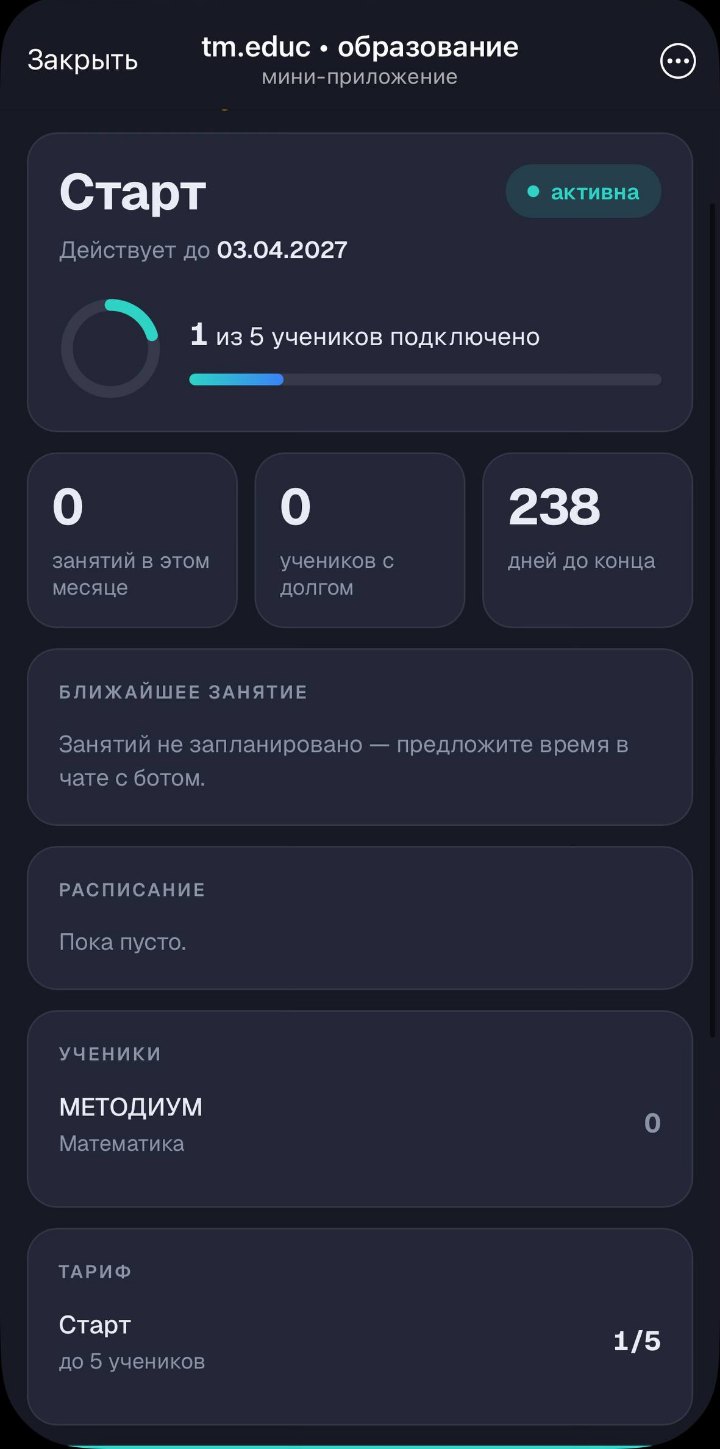
Teacher dashboard
Subscription, lesson counters, the next lesson, the schedule and the student list — the whole picture at a glance.
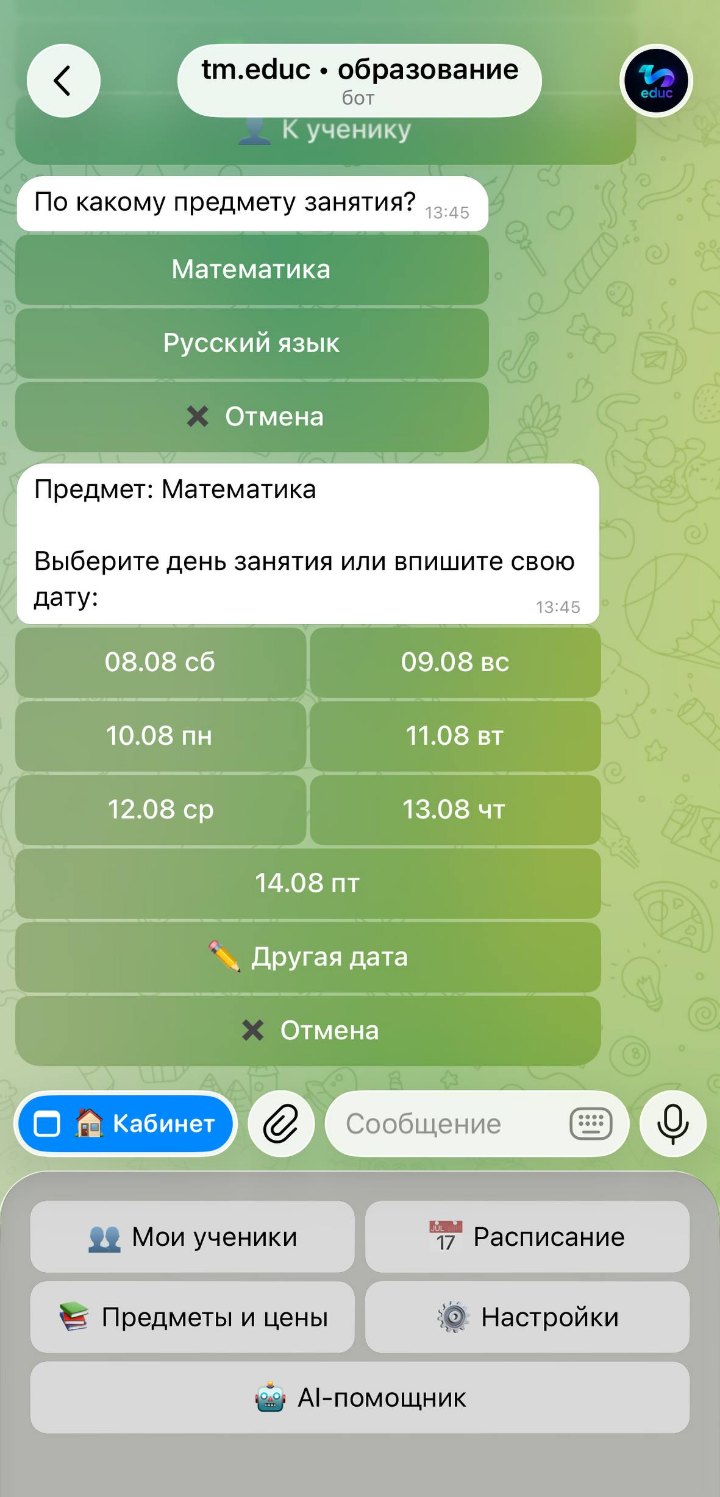
Booking a lesson
The subject, then a day from the coming week or a date of your own. Two steps, and both sides see the same result.
My role
Founder. Designed and built the product alone in 10 days: the role model, lesson accounting, the schedule, the payment logic, the mini app and the AI layer.
The product decisions, the architecture and the flows are mine; AI was the tool that sped the build up. I am now finishing the AI layer and wiring in the knowledge base.
Stack
- Surface
- Telegram Bot
- Telegram Mini App
- Data and retrieval
- PostgreSQL
- pgvector
- RAG
- self-hosted
- Payments
- Robokassa
Current status
The core lesson-accounting loop is already running. What is being finished now is the AI layer: the teacher's assistant, retrieval over a vetted catalogue of books and courses, and a knowledge base to support learning.
A voice interface and an additional channel through MAX are designed but not yet part of the main flow.